
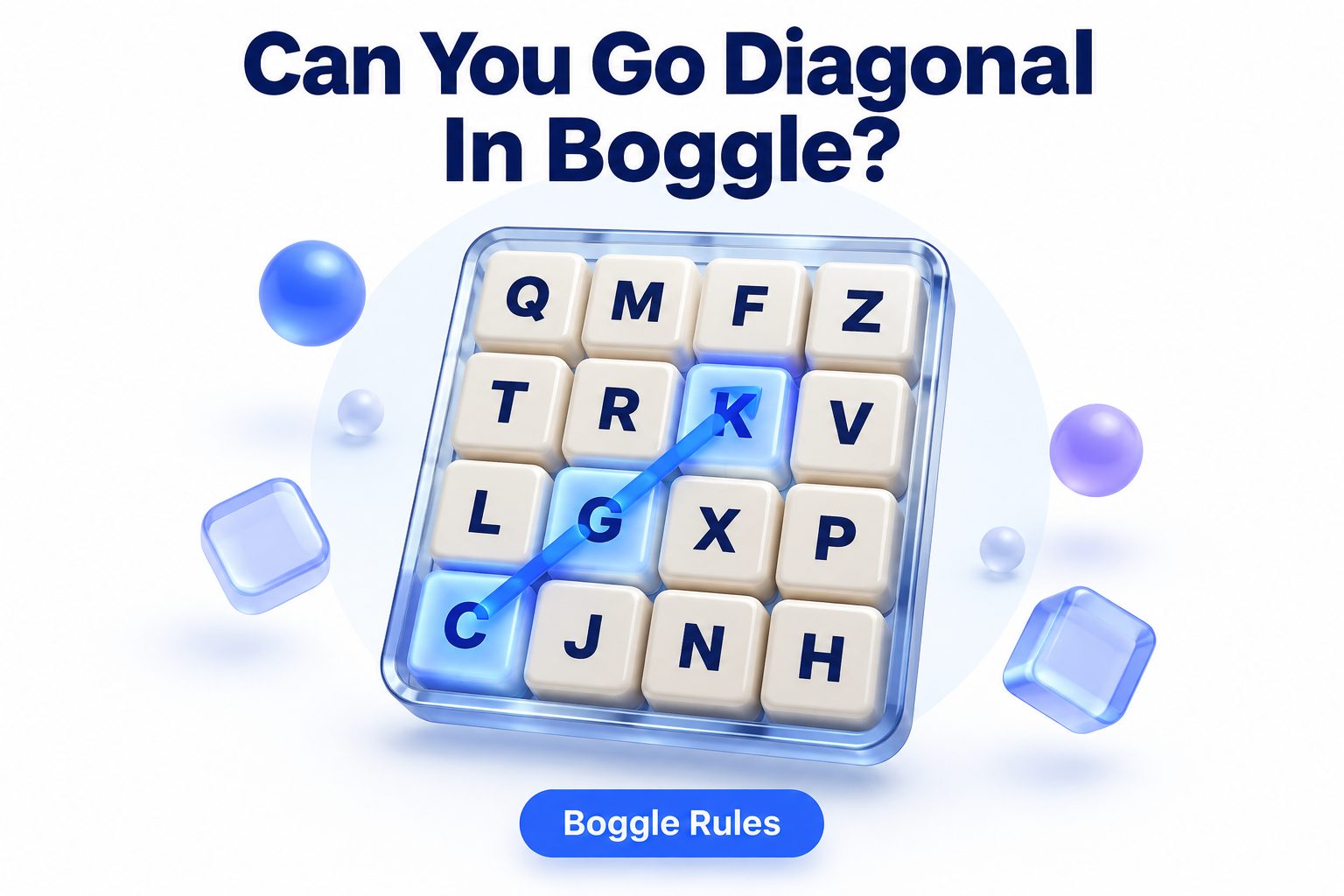
Boggle looks simple at first: shake the letters, start the timer, and build as many words as possible. Yet one rule causes more arguments than almost any other: can you go diagonal in boggle? The answer affects nearly every board, especially when a high-value word appears to run at an angle instead of straight across.
Players who only scan left, right, up, and down miss a large part of the board. Diagonal connections are not a special exception or advanced tactic; they are built into standard Boggle movement. Once you use them confidently, longer words become easier to spot and crowded letter patterns make more sense.
This article explains exactly how diagonal movement works, where it stops, and how to use it without making invalid words. Whether you are playing the classic board game, an online version, or a friendly timed round, the same core principle helps you find more legitimate words.
Boggle Movement Rules at a Glance
In standard Boggle, each letter cube can connect to any cube touching it. That includes letters directly above, below, left, right, and on all four diagonal corners. A letter does not need to be in the same row or column as the previous letter.
The connection must be immediate. You cannot jump over another cube, skip an empty space, or travel across the board to reach a matching letter. Every letter in the word must form one continuous chain of neighboring cubes.
Why Diagonal Letters Matter in Boggle
Diagonal movement gives each cube up to eight possible neighboring cubes, although edge and corner cubes have fewer. This creates many more word paths than a strict horizontal-and-vertical rule would allow, making the game faster, richer, and more competitive.
Common letter combinations often appear diagonally by chance. A diagonal E may complete a word ending, while a diagonal vowel can connect two useful consonants. Ignoring those options can leave short words and high-scoring longer words hidden in plain sight.
Quick Rules for Diagonal Boggle Play
- You may move horizontally, vertically, or diagonally.
- Each new letter must touch the previous letter.
- You cannot reuse the same cube in one word.
- You cannot skip over cubes.
- You may change direction at any point.
- A valid word can contain several diagonal moves.
- The word must meet the dictionary and minimum-length rules for your edition.
How a Diagonal Word Path Works
A diagonal path works exactly like any other Boggle path: trace from one touching cube to the next until the word is complete. The direction can change after every letter, so a word may move diagonally, turn vertically, then continue horizontally.
For example, imagine the letters C, A, T, and S positioned so that C touches A diagonally, A touches T vertically, and T touches S diagonally. “Cats” is valid if each cube is adjacent and none of the cubes is used twice.
Changing Direction During a Word
There is no requirement to keep moving in one direction. Boggle rewards players who follow the letters wherever the board leads. A valid path may zigzag around the board as long as every consecutive pair of letters shares a side or corner.
This flexibility is why tracing with a finger can help during casual games. In competitive play, many people trace mentally to save time, but the underlying rule remains unchanged. The path matters more than whether it looks neat on the board.
Diagonal Moves Near Board Edges
Corner cubes have only three neighboring cubes, while cubes along an edge usually have five. Even so, diagonal routes from these positions can be valuable because they often connect edge letters back into the more flexible center of the grid.
When starting from a corner, look inward rather than assuming the letter is limited. A corner R may connect diagonally to a vowel and open a route through the board. This is especially useful for prefixes such as re-, un-, and de-.
Valid and Invalid Diagonal Connections
A diagonal move is valid only when the two letter cubes meet at a corner. If there is even one cube between them, they are not adjacent. The visual distance between letters can be misleading, so focus on whether their squares physically touch.
Suppose an S is in the top-left corner and an E sits two spaces down and two spaces right. That is not one diagonal move. You would need a connected cube between them, and that intermediate letter would become part of the word.
The No-Reuse Rule
You may not use the same physical cube twice in a single word, even if the letter appears more than once on the board. This rule applies whether the repeated visit would occur through a diagonal, horizontal, or vertical movement.
For instance, if you form “treat,” you need enough separate T cubes to supply both appearances of T. You cannot leave a T, move around the board, and return to that exact same T later in the same word.
Handling the Qu Cube
Traditional Boggle sets include a cube marked Qu, which counts as the letters Q and U together. You may move diagonally to or from that cube just as you would with any other cube. It occupies one board position.
This makes words such as “quiet,” “quite,” and “queen” possible when the following letters connect properly. However, you cannot treat the Qu cube as a standalone Q for words that do not use the U sound represented on the cube.
Common Mistakes to Avoid
- Treating diagonal movement as optional rather than standard.
- Jumping between letters that are close but do not touch.
- Reusing a cube after changing direction.
- Forgetting that Qu represents two letters in classic sets.
- Following a word spelling without checking the physical path.
- Assuming a word is valid because it appears in a general dictionary.
Diagonal Boggle Rules Compared With Other Moves
Movement Type Allowed in Standard Boggle
Horizontal Yes Cubes
Vertical Yes Cubes
Diagonal Yes Cubes
Jumping No Cubes do
Reusing a cube No Each
Using a Qu cube Yes Qu is
How to Find More Diagonal Words
Start by scanning for common endings and connectors, including -ing, -ed, -er, -ly, -tion, and plural S endings. Diagonal letters often supply the final vowel or consonant needed to extend a short word into a longer one.
Instead of reading the board line by line, choose a promising letter and inspect its full neighborhood. Consider every touching cube, not only the obvious straight routes. This habit quickly changes how your eyes process a Boggle grid.
Use Vowels as Turning Points
Vowels are often the best places to change direction. They connect many word patterns and frequently sit between useful consonants. When you see A, E, I, O, or U near the center, test nearby letters in all eight directions.
A central E can support endings such as -ed, -en, -er, and -es, while a nearby diagonal consonant may extend a word further. Treat vowels as hubs rather than merely letters to collect in sequence.
Build From Short Words to Longer Words
Finding a short word first can reveal a larger path. If you spot “rate,” check whether an adjacent diagonal S creates “stare,” “rates,” or “stared,” depending on the available letters and board layout.
This approach is useful under time pressure because the first word establishes a route. You can then test adjacent cubes at the beginning and end, or branch from the middle, without restarting your search from scratch.
Practice Checklist for Better Board Scanning
- Scan center cubes before focusing on corners.
- Check all eight neighbors of promising vowels.
- Test word endings diagonally around final letters.
- Look for prefix letters beside familiar short words.
- Trace every longer word once before submitting it.
- Review missed words after each round to spot patterns.
- Practice with a timer to make diagonal scanning automatic.
Examples of Diagonal Boggle Word Building
Consider a board where the letters S, T, O, N, and E touch in sequence, with T diagonally beside S and E diagonally beside N. “Stone” is valid even though the route changes direction more than once.
The important test is not whether the letters form a visible straight line. Instead, verify each transition: S touches T, T touches O, O touches N, and N touches E. If all links are adjacent, the word qualifies.
Using Diagonals for Word Extensions
A simple word such as “rain” can become “train” if a T touches the R, even diagonally. It can also become “rains” if an S touches the final N. Extensions are often where diagonal awareness produces the biggest score gains.
Try checking both ends of every word you find. Then inspect letters around the middle for possible branches. A path may support a related word with a prefix, suffix, plural ending, or alternate tense, provided no cube is repeated.
Working Around Difficult Letter Clusters
Letters such as X, Z, J, and Q can feel unhelpful, but diagonal neighbors may make them productive. An X beside an E and T may form “ex,” “text,” or “next” through a route that is easy to overlook.
Do not spend all your time forcing rare-letter words, though. Use those cubes when they connect naturally to familiar patterns. A reliable collection of medium-length words usually beats a long search for one uncertain, complicated option.
Diagonal Strategy Tips for Timed Games
- Search for common prefixes around central consonants.
- Look diagonally before abandoning a difficult word path.
- Record obvious three- and four-letter words quickly.
- Return to rare letters only after covering common patterns.
- Test plural and past-tense endings near the edge of the board.
- Avoid arguing over paths until the timer has stopped.
- Keep your eyes moving rather than staring at one cluster.
Playing Boggle With House Rules
Families and groups sometimes create house rules, especially when playing without an official score sheet or dictionary. Some may restrict diagonals for beginners, but that creates a different game from standard Boggle and should be agreed upon before play begins.
If your group changes the movement rules, make the change clear to everyone. A player used to standard Boggle will naturally look diagonally, so silent rule changes can make scoring feel unfair and lead to unnecessary disputes.
Online Boggle and Word Game Variations
Many digital Boggle-style games use the same adjacency system as the physical game. You usually drag across neighboring letters in any direction, including diagonally. The interface may prevent invalid jumps automatically, which makes the rule less visible.
Still, some word games use different boards, dictionaries, minimum word lengths, or special tiles. Check the game’s instructions before assuming every rule matches classic Boggle. For broader scoring advice, see [Boggle word scoring tips].
Settling a Disputed Word Path
When players challenge a word, retrace it slowly from the first letter to the last. Point to each cube in order and confirm that each move reaches a touching cube. This resolves most disagreement immediately and keeps the game friendly.
If the physical path is valid, the next issue is usually dictionary acceptance. Use the dictionary chosen before the round rather than relying on a phone search or personal memory. Consistency matters more than any single disputed word.
Teaching Diagonal Movement to New Players
New players often understand the rule faster when they physically trace a few sample words. Show one horizontal path, one vertical path, and one diagonal path, then demonstrate a word that changes direction across all three movement types.
Give beginners a moment to scan without a timer before introducing full-speed rounds. Once they see that diagonals are ordinary connections rather than trick moves, they start noticing the board as a network instead of a set of rows.
Important Facts Before Your Next Round
- Standard Boggle allows diagonal movement.
- A diagonal connection requires cubes to touch at one corner.
- Direction may change with every letter.
- Each cube can be used only once in a word.
- House rules can differ, but should be announced before play.
- Official dictionary rules may vary by edition or tournament.
- Strong players scan neighboring letters in every direction.
Conclusion
Diagonal movement is one of the central rules that makes Boggle more than a simple word search. It expands the number of possible paths, lets words bend naturally across the board, and rewards players who inspect every neighboring cube. The best approach is to think of each letter as part of a connected map rather than a fixed row or column.
When checking a possible word, confirm three things: every letter touches the next, no cube is reused, and the word is accepted by your group’s chosen dictionary. From there, build speed through practice by using vowels as hubs, testing prefixes and endings, and retracing longer paths before submitting them.
So, can you go diagonal in boggle? Yes—and using diagonal connections confidently is one of the quickest ways to find more valid words and enjoy the game as it was designed.
Frequently Asked Questions
Can you move diagonally more than once in Boggle?
Yes. A word may use several diagonal moves, and it may switch between diagonal, horizontal, and vertical movement at any point. Every consecutive letter simply needs to occupy a touching cube.
Can a Boggle word move in a zigzag pattern?
Yes. Zigzag paths are valid when each next cube shares a side or corner with the previous cube. There is no rule requiring words to travel in a straight line.
Can you reuse a letter cube in Boggle?
No. A cube can appear only once in a single word path. If a word needs the same letter twice, the board must contain two separate usable cubes with that letter.
Does the Qu cube work diagonally?
Yes. The Qu cube may connect diagonally to neighboring cubes in the same way as any other cube. In classic Boggle, it represents both letters together from one position.
Do all Boggle versions use diagonal rules?
Most classic Boggle versions do, but digital games and house-rule variations can differ. Read the specific game instructions before playing, particularly when the board size, tiles, or scoring system changes.
0 Comments